Table of Contents
Quick Summary
Organize makeup and skincare by routine step, not product type: keep your daily-use products (cleanser, moisturizer, everyday makeup) in a tiered tray or drawer insert within easy reach, and move backups, occasional products, and rarely used makeup to a separate bin or a different room's storage entirely. This keeps daily surfaces from being overwhelmed by an entire collection.
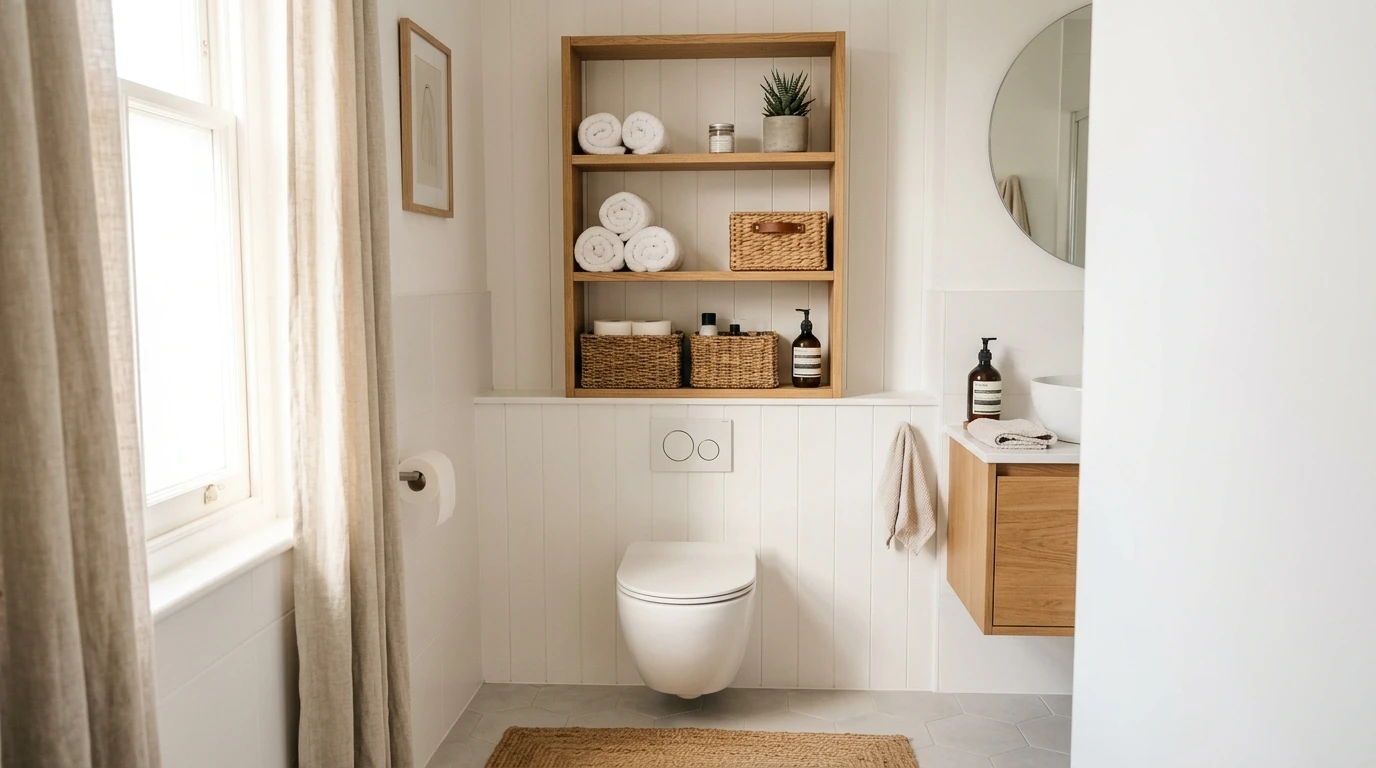
Makeup and skincare collections tend to grow faster than the storage space allotted for them, especially in a small bathroom where the sink area might only offer a few inches of usable surface. The instinct is to buy a bigger organizer, but the more sustainable fix is usually to separate what you actually use daily from the larger collection sitting mostly unused.
This guide sets up a routine-based system: daily products get prime, easy-access storage, and everything else gets moved somewhere less central, whether that's a drawer, a bin on a shelf, or even a bedroom dresser. This approach also scales naturally as a collection grows or shrinks over time, since only the daily list needs to stay small, the secondary storage can flex without affecting how the bathroom itself feels, whether that collection is modest or fairly extensive, and it avoids the common trap of buying ever-larger bathroom storage simply to keep pace with a growing collection that could just as easily live somewhere else.
See also How to Organize a Tiny Bathroom With No Counter Space for a closer look at a related project.
Sort by your actual routine, not by product category
Rather than grouping all skincare together and all makeup together, think through your actual morning and evening routine step by step, and identify which specific products you touch every single day. This is usually a much smaller list than a full inventory of everything owned.
Everything on that daily list deserves the most convenient storage spot; everything else, including backups and occasional-use items, can move to secondary storage without slowing down your daily routine. Most people are surprised at how short the true daily list turns out to be once they actually track it for a week rather than estimating from memory.
Use a tiered tray for daily products
A small tiered tray, sized to fit on even a narrow ledge or the top of a medicine cabinet, lets you see every daily product at a glance instead of digging through a flat pile. This is especially useful for skincare bottles and jars of similar height, which tend to blend together when placed directly on a flat surface. A two-tier tray typically fits comfortably in a footprint of about eight by five inches, which makes it one of the few storage products genuinely sized for the smallest bathroom ledges.
We go deeper on this topic in How to Organize Jewelry and Accessories in a Tiny Bedroom.
Use a drawer insert if you have a spare drawer
If there's a spare drawer near the sink, a compartmentalized insert keeps makeup items like brushes, lipsticks, and small palettes separated and visible from above, similar to the drawer tray approach used for jewelry. This works especially well for makeup, since compartments prevent items with different shapes from sliding together into a jumble.
If this is useful, you may also want The 30-Day Declutter Challenge for Apartments.
Move the rest out of the bathroom entirely
For a larger collection than the bathroom has room to store, consider keeping backups and rarely used items in a bedroom dresser drawer or a labeled bin in a bedroom closet, rather than trying to fit an entire collection into a small bathroom. Pull from that secondary storage only when a daily-use product runs out and needs replacing.
A real example: a growing collection outpacing a tiny ledge
In one small apartment bathroom with only about eight inches of ledge space around the sink, a growing skincare and makeup collection had spread across every available surface, including the top of the toilet tank and the edge of the bathtub, making the whole room feel cluttered despite a relatively modest total collection size.
The fix started with identifying the actual daily routine: five skincare products and three makeup items used every morning. Those eight items moved onto a $14 tiered tray that fit the narrow ledge exactly. Everything else, roughly three times as many products, moved into a labeled bin in a bedroom closet, pulled out only when something on the tray ran out. The bathroom ledge went from overflowing to holding exactly what was used daily, with the larger collection still fully accessible, just not competing for the same eight inches of space. A quarterly check-in, moving anything that had quietly become a daily habit onto the tray and retiring anything on the tray that had fallen out of rotation, kept the system matched to the actual routine as it changed with the seasons.
Browse more Bathroom Organization guides for additional ideas.
| Item type | Frequency | Best storage |
|---|---|---|
| Daily skincare | Daily | Tiered tray on ledge or cabinet top |
| Daily makeup | Daily | Drawer insert or small tray |
| Backup products | Occasional | Bin in a bedroom closet or under-sink cabinet |
| Special-occasion makeup | Rare | Labeled bin, secondary storage |
Tip
Do a quick check every few months for products past their typical shelf life (many skincare and makeup products have a small open-jar symbol indicating months of use after opening) and remove any expired items before they take up daily-use space.
Watch Out For
Avoid storing skincare or makeup directly next to a shower or in high humidity for extended periods, since heat and moisture can degrade some formulas and shorten their usable life faster than the listed shelf date suggests.
Common Mistakes
- Trying to display an entire collection on a small ledge instead of separating daily-use items from the rest.
- Storing products by category instead of by how often they're actually used in a real routine.
- Letting backups accumulate in the bathroom instead of moving them to secondary storage elsewhere.
- Ignoring shelf-life symbols and holding onto expired skincare or makeup indefinitely.
- Storing sensitive products in a consistently humid spot near the shower.
Quick Recap
- Identify the specific products used in your actual daily routine.
- Give daily-use items the most convenient storage, like a tiered tray.
- Use a drawer insert for makeup if a spare drawer is available.
- Move backups and rarely used items to secondary storage outside the bathroom.
- Check periodically for expired products and remove them.
Frequently Asked Questions
How do I organize makeup in a bathroom with very little space?
Separate your daily-use products from the rest of your collection, keep only the daily items in the bathroom on a tiered tray or drawer insert, and store backups elsewhere, like a bedroom closet.
Should skincare be stored near the shower?
It's better to avoid consistent heat and humidity exposure where possible, since it can shorten the usable life of some formulas faster than their listed shelf life.
What's the best way to store makeup brushes in a small bathroom?
A small upright holder or a compartment in a drawer insert works well, keeping brushes visible and separated without taking up much surface space.
How do I stop a small bathroom ledge from getting cluttered with beauty products?
Limit the ledge to only the handful of products used in your actual daily routine, and move everything else to a drawer, tray, or secondary storage location.
How often should I check makeup and skincare for expiration?
Every few months is a reasonable routine, checking any shelf-life symbols on packaging and removing products that are past their typical usable window.
Conclusion
A small bathroom doesn't need to store an entire makeup and skincare collection at once, it only needs to store what's used in your actual daily routine. Keep that smaller set in a tiered tray or drawer insert within easy reach, move the rest to secondary storage elsewhere in the home, and periodically check for expired products so the daily set stays current and useful.

Real Home Habits Editorial Team
Real Home Habits Editorial Team writes practical, step-by-step home organization guides for renters, small-space dwellers, and busy families.