Table of Contents
- Hanging caddies for a fixed showerhead
- Suction and adhesive caddies for smooth tile or glass
- Tension-pole caddies for showers with nothing to hang from
- Built-in corner shelves for two usable tiled corners
- A real example: matching the caddy to a difficult shower
- Common Mistakes
- Quick Recap
- Frequently Asked Questions
Quick Summary
Match a shower caddy to your shower's setup: a hanging caddy works with any showerhead and needs no installation, a suction or adhesive caddy works on smooth tile or glass, a tension-pole caddy suits a shower with no showerhead to hang from, and a corner shelf works well if you have two tiled corner walls at a usable angle.
Shower caddies fail most often not because of quality, but because of a mismatch with the specific shower they're installed in, a suction caddy on textured tile that won't hold suction, or a hanging caddy on a handheld showerhead with no fixed arm to hook onto. Getting this right starts with an honest look at what your shower actually offers to attach to.
This guide breaks down the main caddy types by shower setup, so you can pick the one that will actually stay put instead of ending up back on the shower floor within a week. Spending a few minutes assessing your specific shower before ordering anything is a small step that prevents most of the returns and re-purchases people end up making with shower storage, and it typically takes less time than a single trip to return a product that didn't fit.
See also How to Organize a Tiny Bathroom With No Counter Space for a closer look at a related project.
Hanging caddies for a fixed showerhead
A hanging caddy loops over the shower arm (the pipe the showerhead attaches to) and needs no installation at all, making it one of the most reliable, renter-friendly options available. It works well for showers with a traditional fixed showerhead, though it isn't compatible with handheld-only setups that lack a rigid arm to hang from.
Look for a model with a tension mechanism or rubberized grip where it meets the pipe, since a loose hanging caddy can swing and rattle every time the water turns on. Rust resistance is also worth checking on the product description, since a caddy that sits in constant humidity needs a coating that can handle it long-term without corroding at the joints.
Suction and adhesive caddies for smooth tile or glass
Suction-cup or strong adhesive-backed caddies work well on smooth surfaces like glass shower doors or glazed tile, but they generally fail on textured, matte, or grouted surfaces where there isn't enough smooth contact area for a reliable seal.
Before buying, run a hand across your shower wall: if it feels smooth and glass-like, suction or adhesive mounting is likely to work; if it feels textured or matte, look at a different mounting style instead. Grout lines are also worth checking, since a caddy positioned directly over a grout line rarely holds as reliably as one placed fully on a single smooth tile.
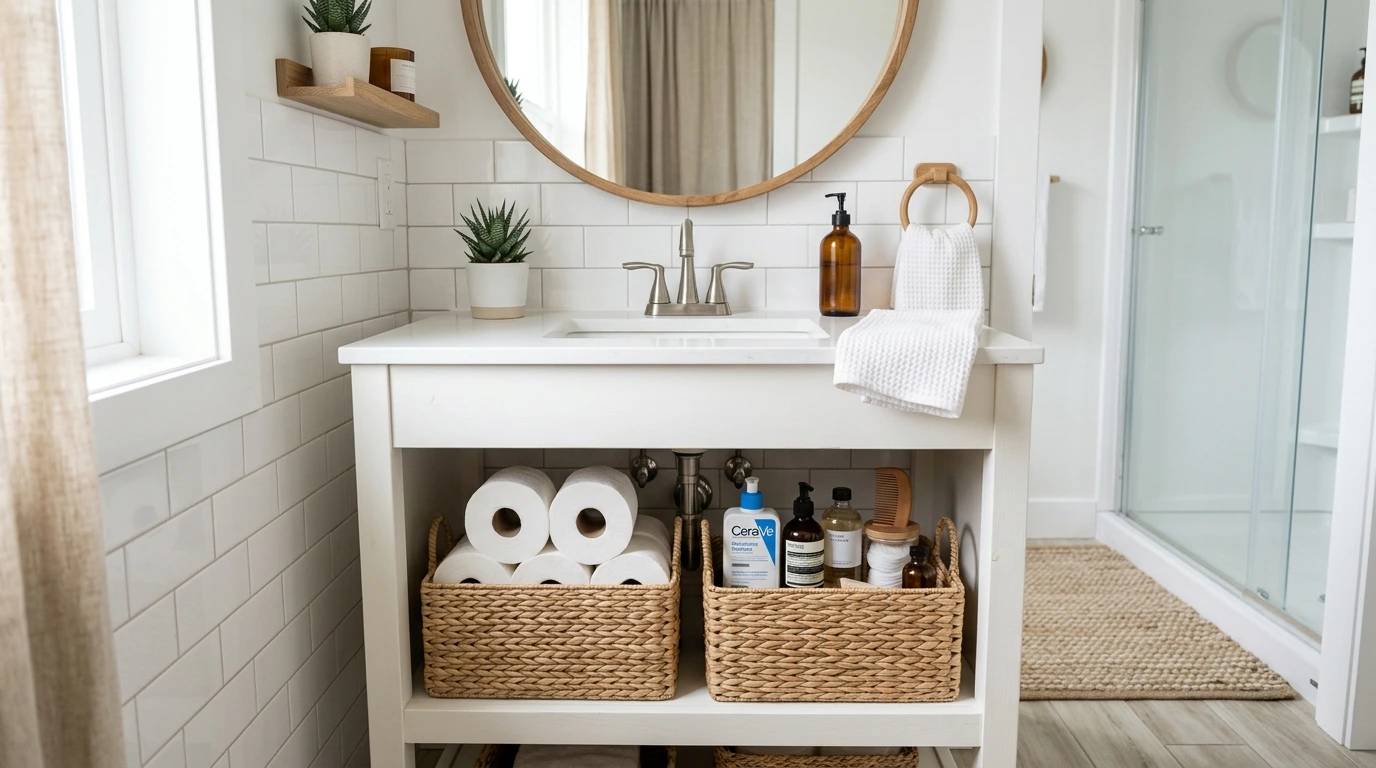
We go deeper on this topic in Under-Sink Bathroom Storage Ideas for Renters.

Tension-pole caddies for showers with nothing to hang from
A tension pole caddy wedges between the shower floor and ceiling (or between two walls in a corner), providing several shelves without needing a showerhead, smooth wall, or any drilling. This is the most flexible option for an awkward shower with a handheld-only head and rough tile, though it needs enough vertical clearance to wedge securely.
See also How to Organize Important Documents in a Small Home for a closer look at a related project.
Built-in corner shelves for two usable tiled corners
If your shower has a corner with two intersecting tiled walls at a workable angle, a corner shelf (either adhesive-mounted or resting on a small footed base) can hold a surprising amount without taking up any floor or door-arm space. This option works best in a shower stall rather than a tub-shower combo, where corner space is often more awkward to reach.
A real example: matching the caddy to a difficult shower
In one rented apartment, the shower had a handheld showerhead with no fixed arm, rough unglazed tile that suction cups wouldn't grip, and low ceiling clearance that ruled out a full-height tension pole. The first two caddy types purchased, a hanging model and a suction model, both failed within the first week.
The eventual fix was a short tension-pole caddy sized for the specific ceiling height, wedged into a back corner rather than centered in the shower. It held firmly because it didn't depend on a showerhead arm or a smooth surface at all, only on the tension between floor and ceiling. The lesson from two failed purchases was to measure and test the wall surface and available anchor points before buying, rather than assuming the most popular caddy style would work in every shower. The two failed products weren't wasted entirely; the hanging caddy found a second life over a closet door for hair tools, while the suction caddy was returned, which is worth checking on any borderline purchase before writing it off as a loss.
You might also like 15 Bathroom Storage Ideas Under $30.
For more like this, visit our Bathroom Organization guides.
| Your shower has... | Best caddy type | Installation |
|---|---|---|
| A fixed showerhead arm | Hanging caddy | None, hooks over the arm |
| Smooth glass or glazed tile | Suction or adhesive caddy | None to minimal |
| Textured tile, handheld head only | Tension-pole caddy | Wedges in place, no drilling |
| Two tiled corner walls | Corner shelf | Adhesive or footed base |
Tip
Before buying any caddy, run your hand across the shower wall to check whether it's smooth or textured, and note whether the showerhead is fixed or handheld-only. These two facts alone rule out most of the wrong options.
Watch Out For
Avoid overloading a suction or adhesive caddy with heavy glass bottles, since prolonged exposure to steam and water can weaken the hold over time even on a smooth surface.

Common Mistakes
- Buying a hanging caddy for a shower with only a handheld showerhead and no fixed arm.
- Choosing a suction caddy for textured or matte tile without testing whether it actually holds.
- Overloading any mounted caddy with more weight than its type is designed to support.
- Buying a tension-pole caddy without measuring ceiling height and clearance first.
- Repeatedly buying the same failed caddy type instead of switching to a different mounting method.
Quick Recap
- Identify whether your showerhead is fixed or handheld-only.
- Test whether your shower wall is smooth enough for suction or adhesive mounting.
- Choose a tension-pole caddy if neither a hanging nor a suction option fits your setup.
- Use a corner shelf if you have two usable tiled corner walls.
- Check weight ratings before loading any caddy with full-size bottles.
Frequently Asked Questions
What's the best shower caddy for a rental apartment?
A hanging caddy (for a fixed showerhead) or a tension-pole caddy (for any shower) are both fully renter-friendly, since neither requires drilling into tile or walls.
Why does my suction shower caddy keep falling?
Suction and strong adhesive mounts need a smooth, non-textured surface to hold reliably; on matte or grouted tile, they often fail regardless of brand or price.
What shower caddy works with a handheld showerhead?
A tension-pole caddy or a corner shelf, since both mount independently of the showerhead arm that a hanging caddy relies on.
How do I know if my shower can hold a corner shelf?
Check whether you have two intersecting tiled walls at a workable angle within the shower; this option works best in a stall shower rather than a tub-shower combination.
Do shower caddies damage tile?
Tension-pole and hanging caddies generally don't touch the tile at all; adhesive-mounted options can sometimes leave residue on removal, so it's worth checking the product's removal instructions first.
Conclusion
There's no single best shower caddy, only the caddy type that actually matches your shower's showerhead, wall surface, and available anchor points. Check whether your showerhead is fixed or handheld, test your wall surface for smoothness, and choose a hanging, suction, tension-pole, or corner-shelf caddy accordingly, rather than guessing and hoping the most popular option happens to work.

Real Home Habits Editorial Team
Real Home Habits Editorial Team writes practical, step-by-step home organization guides for renters, small-space dwellers, and busy families.