Table of Contents
- Create a backpack and shoe zone by the entryway
- Set up a small supply station
- Give school paperwork one consistent spot
- Set up a flexible homework spot, not necessarily a dedicated room
- Involve kids in setting up their own zones
- A real example: solving morning chaos in a two-bedroom apartment
- Common Mistakes
- Quick Recap
- Frequently Asked Questions
Quick Summary
Organizing a small home for the school year isn't about buying expensive container systems. It starts with a low entryway hook for backpacks, a portable caddy for homework supplies, a dedicated tray for time-sensitive forms, and a flexible desk or kitchen corner for homework. Involving your children when setting up these zones turns daily chores into automatic habits.
When late August arrives, a tidal wave of backpacks, permission slips, art projects, and lunchboxes washes over the average household. In a small apartment where floor space is already precious, those items usually end up dumped on the nearest sofa or kitchen counter. Before you know it, every morning starts with frantic searches for missing shoes or unsigned field trip forms.
The solution isn't building a costly mudroom or converting a bedroom into a private classroom. It comes down to establishing four simple, consistent zones where items land the second your kids step through the front door. Here is how to build a routine that actually holds up through the school year.
Create a backpack and shoe zone by the entryway
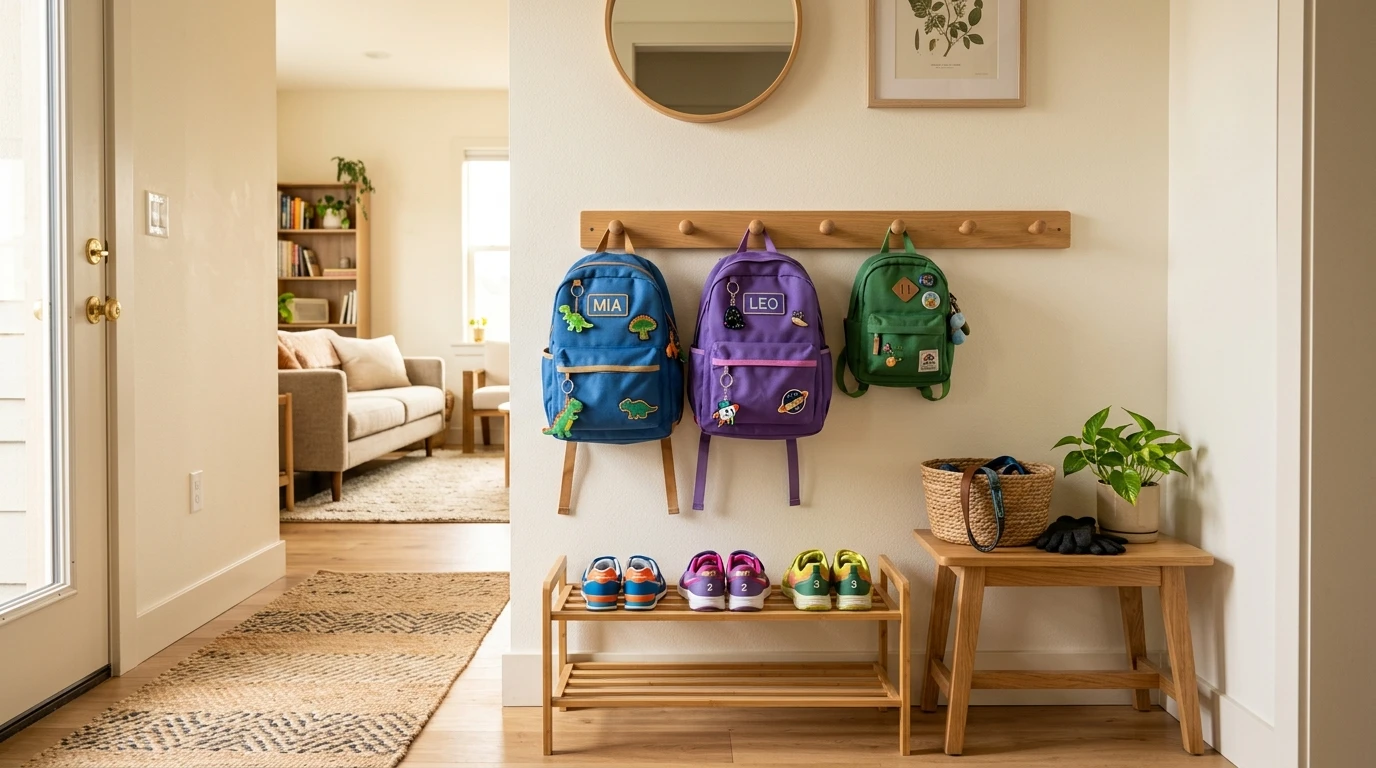
Every apartment entryway can handle a few heavy-duty hooks. Mount them low enough so your youngest child can reach without stretching or asking for help. Pair each hook with a open shoe bin or a low mat right underneath.
When kids come home tired, they take the path of least resistance. If hanging up a bag requires opening a closet door or fetching a clothes hanger, the bag ends up on the floor. A single, dedicated hook at shoulder height eliminates that friction. It gives the backpack an immediate home before anyone walks into the living room.
Set up a small supply station
Searching for a sharpened pencil or a glue stick at 7:45 AM ruins morning momentum. Instead of scattering school supplies across multiple drawers, consolidate the basics into one portable supply caddy or a shallow tote.
Fill it with everyday essentials: sharpened pencils, erasers, a ruler, glue sticks, and scissors. During study time, the caddy moves to the kitchen table. Once homework finishes, everything goes back inside the caddy, and the entire unit rests on a single bookshelf. Portable storage keeps your living surfaces clutter-free while ensuring kids always know where to find what they need.
Give school paperwork one consistent spot
School notices, medical forms, and permission slips carry tight deadlines. Stashing them in a general paper pile alongside bills and junk mail almost guarantees missed dates.
Set up one wall-mounted file pocket or a small magnetic clip near the entryway specifically for action paperwork. Establish a single rule: any form requiring a parent signature goes straight into that pocket when bags are unpacked. Check the pocket every evening after dinner, sign what needs signing, and tuck the forms right back into the backpack for the next morning.
Set up a flexible homework spot, not necessarily a dedicated room
Few small apartments have space for a dedicated home office or study room for every child. Fortunately, kids don't need a private room to focus. A dining table, a corner of the kitchen counter, or a small drop-leaf desk works remarkably well.
What matters is consistency in environment. Clear the table of meal dishes, bring out the supply caddy, and minimize background distractions like loud TV audio during study hours. When homework finishes, put the caddy away so the dining table transforms back into a family eating space.
Involve kids in setting up their own zones
Organizational systems fail when parents design them in isolation. Children stick to routines far more reliably when they feel a sense of ownership over their space.
Let your kids choose the color of their backpack hook or write their own names on their supply caddy labels. Walk them through the afternoon routine: shoes on the mat, bag on the hook, paperwork in the tray. Practice it together during the first week of school until the sequence becomes second nature.
A real example: solving morning chaos in a two-bedroom apartment
A family of four living in a 750-square-foot apartment was struggling with chaotic weekday mornings. Backpacks blocked the hallway, school supplies were buried under living room cushions, and permission slips frequently went missing.
Instead of buying bulky furniture, they made three targeted changes. First, they installed four sturdy wall hooks near the front door at a 3-foot height for backpacks and coats. Second, they designated a portable plastic caddy for pencils and notebooks, stored on a low kitchen shelf. Third, they added a single acrylic wall pocket by the door for school forms.
Within ten days, morning delays dropped significantly. The children took pride in hanging up their bags, and signed forms were ready by the door every evening. A simple system tailored to child height solved a problem that extra storage cabinets never could.
See our full Systems, Habits & Seasonal guides for more related guides.
| Zone | Purpose | Location |
|---|---|---|
| Backpack & shoe hooks | Consistent daily drop-off spot | Entryway, mounted at child height |
| Supply caddy | Quick access to everyday study tools | Portable bin or kitchen drawer |
| Action paper pocket | Time-sensitive forms requiring parent review | Near entryway, checked daily |
| Flexible study spot | Quiet, clutter-free work area | Kitchen table, living corner, or folding desk |
Tip
Run a 10-minute trial run a week before the school term starts. Check backpack hook heights, sharpen pencils, and confirm supply stock so you are not troubleshooting on morning one.
Watch Out For
Don't make the daily routine complicated. Multi-step rules like opening three drawers or sorting paper into color-coded folders will be abandoned quickly by young kids. Stick to one-step actions.
Common Mistakes
- Mounting backpack hooks too high for young children to reach on their own.
- Burying urgent school paperwork inside general household paper stacks.
- Assuming children need a dedicated study room rather than a well-managed table space.
- Building a storage system without getting input from the kids who will use it.
- Creating multi-step sorting rules that confuse younger family members.
Quick Recap
- Mount entryway backpack hooks at a height your kids can reach easily.
- Keep homework essentials in one portable, easy-to-store caddy.
- Reserve one checked-daily pocket for time-sensitive school forms.
- Use a flexible table setup for homework instead of forcing a dedicated room.
- Give children a hand in personalizing their own organization spots.
Frequently Asked Questions
Do I need a dedicated mudroom for back-to-school organization?
No. Two sturdy wall hooks mounted at child height and an open shoe mat in your entryway accomplish the exact same goal in a small apartment.
How can I avoid losing permission slips and school forms?
Keep a single wall pocket or clip near the front door reserved strictly for action paperwork. Check and clear it every evening after dinner.
Where should kids do homework if we don't have a spare room?
A kitchen table or a small folding desk works perfectly. The key is bringing out a dedicated supply caddy during study time and storing it away when done.
How do I encourage my kids to actually use the backpack hooks?
Let them choose their hook or tag, and mount it at their shoulder height. Practice the drop-off routine together during the first week of school.
When should we set up our back-to-school organization system?
About one week before the first day of school. This gives you time to check supply stock and adjust hook heights before the morning rush begins.
Conclusion
Organizing a small home for the school year comes down to four simple, low-friction anchor points. Low backpack hooks, a portable supply caddy, an action paperwork pocket, and a flexible homework space work together to eliminate morning scramble. When children help set up these zones, daily habits form naturally without constant parent reminders.

Real Home Habits Editorial Team
Real Home Habits Editorial Team writes practical, step-by-step home organization guides for renters, small-space dwellers, and busy families.