Table of Contents
Quick Summary
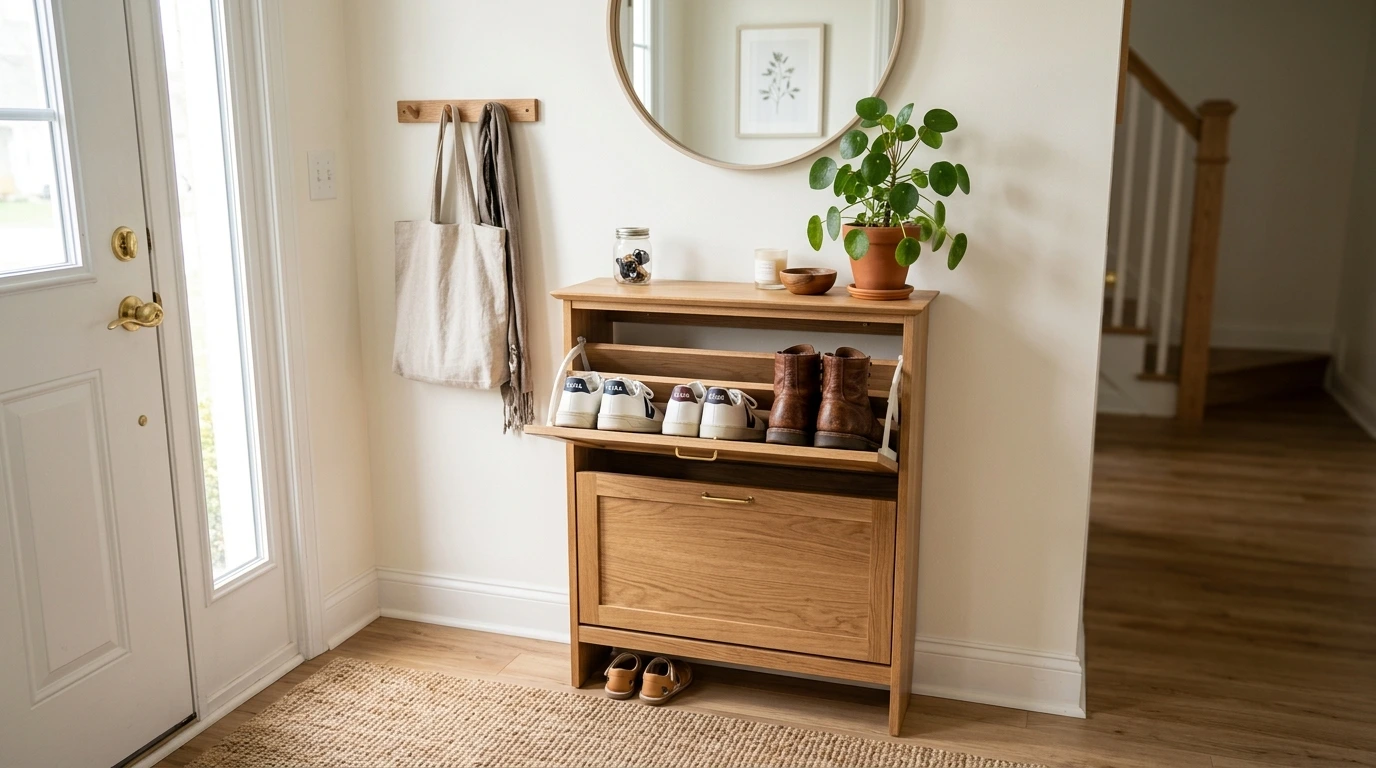
Organize a small or nonexistent apartment entryway using wall-mounted hooks for coats and bags, a slim console table or shelf for a keys-and-mail landing zone, and a boot tray or small shoe rack near the door. Even a strip of wall two feet wide can hold all three elements if chosen at an appropriately narrow scale.
A lot of apartments, especially smaller or older ones, don't have a true entryway or mudroom at all, just the front door opening directly into the living room, with maybe a couple of feet of wall space beside it. It's easy to assume this means there's no real option for organized entry storage, but even a narrow strip of wall can function as a genuine landing zone with the right, appropriately scaled pieces.
This guide covers how to build a working entryway system in a space that was never designed to be one, focusing on wall-mounted and slim-profile options that don't require dedicated floor space.
We go deeper on this topic in Renter-Friendly Floating Shelf Ideas for Small Spaces.
Start with wall-mounted hooks
A row of two or three hooks, mounted with adhesive strips for renters, is often the single highest-value addition to a small entryway, since it gets coats and bags up off the floor and out of the way without using any floor space at all. Position hooks at a height that's actually comfortable to reach, rather than as high as possible to save wall space, since hooks that are awkward to use tend to get skipped in favor of dropping items on the floor.
Add a small landing zone for keys and mail
A slim wall-mounted shelf, a small wall-mounted key rack with a tray, or a narrow console table if floor space allows, gives keys, mail, and a wallet one consistent spot the moment you walk in. This single change prevents the common problem of keys ending up in a different spot every day, making the morning search for them a regular occurrence.
Even a small dish attached to the wall or sitting on a two-inch-deep shelf is enough for this purpose; the landing zone doesn't need to be large, just consistent.
Use a boot tray or slim shoe rack
A slim boot tray catches dirt and moisture from shoes without needing a full rack, and it works even in an entryway too narrow for a bench or cubby system. For a slightly wider space, a low, narrow shoe rack can hold several pairs while still leaving room to step around it, covered in more detail in our dedicated shoe storage guide.
Consider a slim bench if space allows
If there's at least a couple of feet of floor space available, a narrow bench, ideally one with storage underneath or a lift-up seat, provides a place to sit while putting on shoes and doubles as storage. This isn't essential in a genuinely tight entryway, but it's a strong addition when the space allows for it.
For more on this, see How to Organize Important Documents in a Small Home.
Set a hard rule about what stays by the door
Without a rule, an entryway zone tends to accumulate far more than coats, keys, and shoes, packages, gym bags, and miscellaneous items all drift toward the door and stay there. Deciding on a short, specific list of what's allowed to live in this zone, and relocating everything else the same day it arrives, keeps even a very small entryway from becoming a general clutter catch-all.
A real example: two feet of wall becoming a full system
In a studio apartment where the front door opened directly into the main living space with no defined entry area at all, coats had been draped over a dining chair, shoes piled directly on the floor, and mail scattered across the kitchen counter for lack of a better spot.
The fix used exactly two feet of wall beside the door: three adhesive hooks at a comfortable reaching height for coats and a bag, a small wall-mounted shelf with a shallow dish for keys and mail, and a slim boot tray on the floor beneath. Total cost was under $30. The dining chair went back to being used only for dining, the kitchen counter cleared of scattered mail, and every item crossing the threshold finally had a specific, close-at-hand spot, despite the apartment never having been designed with an entryway in mind. The one rule that made it last was treating that two-foot strip of wall as off-limits for anything beyond the agreed list of coats, bags, keys, mail, and shoes, with anything else redirected elsewhere the same day it appeared.
Browse more Living Room & Home Office guides for additional ideas.
| Available space | Best addition | Approx. Cost |
|---|---|---|
| A narrow strip of wall only | Adhesive hooks + small shelf | $15-$25 |
| Wall plus a small floor footprint | Add a boot tray | $10-$15 more |
| A couple of feet of floor space | Slim storage bench | $40-$80 |
| Any entryway | A hard rule on what's allowed there | Free |
Tip
Mount hooks at the height that's actually comfortable for the tallest regular user of the household, rather than a generic "average" height, since a hook that's awkward to reach daily tends to get bypassed in favor of dropping items on the floor.
Watch Out For
Avoid blocking a doorway's swing radius or a required exit path with entryway furniture, even a slim bench, both for daily convenience and for basic safety in an emergency.

Common Mistakes
- Assuming an apartment with no defined entryway has no real storage options near the door.
- Mounting hooks too high to save wall space, making them inconvenient enough to skip in daily use.
- Skipping a landing zone for keys and mail, leading to a daily search for both.
- Letting the entryway zone absorb unrelated clutter without a clear rule on what belongs there.
- Placing entryway furniture in a way that blocks the door's swing radius or an exit path.
Quick Recap
- Add wall-mounted hooks at a genuinely comfortable reaching height.
- Set up a small, consistent landing zone for keys and mail.
- Add a boot tray or slim shoe rack near the door.
- Add a slim bench if at least a couple of feet of floor space allow it.
- Set a hard rule on what's allowed to live in the entryway zone.
Frequently Asked Questions
What do I do if my apartment has no entryway at all?
Even a narrow strip of wall beside the front door can hold hooks, a small shelf, and a boot tray, functioning as a working entryway system without needing a dedicated room.
How high should entryway hooks be mounted?
At a height that's genuinely comfortable to reach for the household's regular users, rather than as high as possible to save wall space, since awkward-to-reach hooks tend to go unused.
What's the most important entryway addition in a small apartment?
Wall-mounted hooks are usually the highest-value single addition, since they clear coats and bags off the floor without using any floor space.
How do I stop keys and mail from getting lost every day?
Set up one small, consistent landing zone right by the door, even just a shallow dish on a shelf, so keys and mail have the same spot every single time.
Can a boot tray work without a full entryway bench?
Yes, a slim boot tray can be used entirely on its own in a tight space, without needing an accompanying bench or shoe rack.
Conclusion
An apartment doesn't need a real, architecturally defined entryway to have a working entry storage system, even a narrow strip of wall beside the front door is enough for hooks, a landing zone, and a boot tray. Set a clear rule about what belongs in that zone, and the system will keep working even as the rest of the apartment stays busy.

Real Home Habits Editorial Team
Real Home Habits Editorial Team writes practical, step-by-step home organization guides for renters, small-space dwellers, and busy families.