Table of Contents
Quick Summary
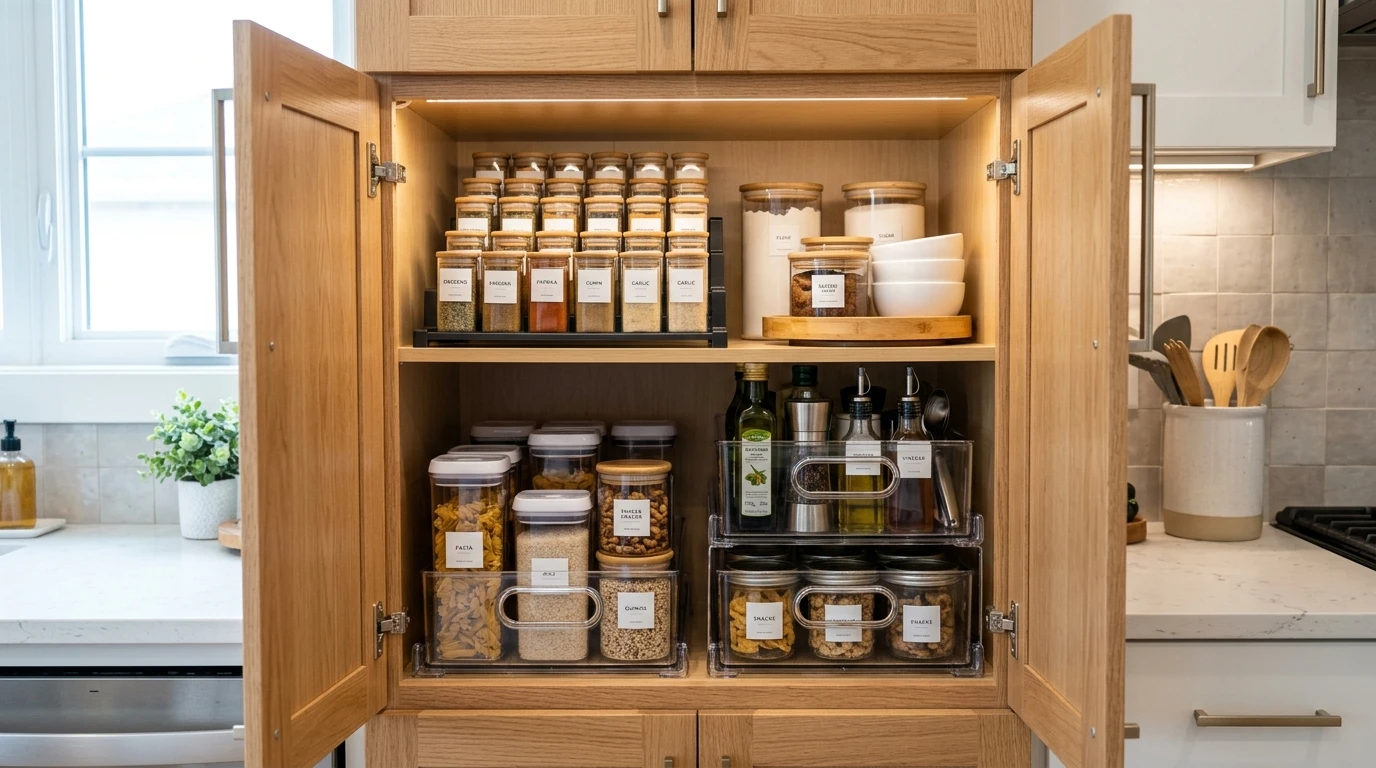
The organizers that help most in a small, rented kitchen are ones that add usable levels instead of just holding items: shelf risers, pull-out bins, door-mounted racks with adhesive backing, and lazy Susans for corner cabinets. Skip anything that only fits one specific product, since small kitchens need flexible storage more than specialty gadgets.
Cabinet organizers are an easy way to spend money and end up with less usable space than before, because a lot of them are designed for cabinets that are already generously sized. In a small, rented kitchen, the organizers that actually help are the ones that create new usable space, a second level, a pull-out layer, or vertical dividers, rather than ones that just hold one type of item.
This guide breaks down which cabinet organizers are genuinely worth the space and money for a small kitchen, and which ones tend to sit half-used after the first month. Every option here avoids drilling or permanent modification, so it works whether you own or rent.
For more on this, see Smart Under-Sink Storage Ideas for Apartments.
Shelf risers: the highest value-per-dollar option
A stackable shelf riser sits on your existing cabinet shelf and adds a second tier above it, instantly doubling usable space for anything short, like mugs, small plates, or spice jars. Because they simply rest on the shelf, there's nothing to install and nothing to remove when you move out.
They work best in cabinets with a few inches of dead air above your items, a common situation in small kitchens where shelves are spaced for average dish height, not actual usage. Metal wire risers tend to hold more weight than plastic ones, which matters if you're stacking anything ceramic.
Pull-out bins and drawers
Free-standing pull-out bins sit inside a cabinet like a drawer but slide forward on their own, so you're not reaching into the dark back corner of a deep cabinet. These are especially useful under the sink or in a deep base cabinet where items get lost behind each other.
Because they're free-standing rather than track-mounted, they can be removed instantly and reused in your next kitchen, which makes them one of the more move-friendly options on this list.
If this is useful, you may also want How to Organize Pots, Pans, and Lids Without a Big Pantry.
Adhesive-backed door organizers
The inside of a cabinet door is often unused vertical space. Racks that attach with strong adhesive strips (rated for kitchen use, not general-purpose tape) can hold cutting boards, foil and wrap boxes, or cleaning supplies without a single screw.
Always check the adhesive's weight rating before loading it up, and avoid placing heavy glass or ceramic items on adhesive-mounted racks, save those for shelf-based storage instead.
Lazy Susans for corner cabinets
Corner cabinets are notorious dead zones in small kitchens, since the back corner is nearly impossible to reach without pulling everything else out first. A simple turntable, or lazy Susan, solves this by letting you spin items into reach instead of reaching around them.
Two-tier turntables are worth the small extra cost over single-tier ones in a small kitchen, since they roughly double what one corner cabinet can hold.
You might also like Best Under-Bed Storage Solutions for Apartments and Condos.
What to skip
Single-purpose organizers, a rack that only holds one brand of spice jar, or a bin shaped for one specific appliance, rarely earn their space in a small kitchen, because your grocery brands and appliances change over time. Prioritize flexible, general-purpose organizers over anything built for one exact product.
A real example: turning one dead corner cabinet around
Picture a typical rented one-bedroom kitchen: a corner base cabinet where anything pushed to the back corner is essentially gone until the next deep clean, plus a narrow cabinet above the fridge that's too awkward to reach without a step stool. Before any changes, both cabinets get used as overflow, extra grocery bags shoved in, a half-used bag of flour lost behind a mixing bowl.
The fix took under an hour and cost about $18: a two-tier lazy Susan in the corner cabinet, and a single shelf riser above the fridge to split that awkward tall gap into two usable, visible levels instead of one deep unreachable one. Nothing was thrown away, and no drilling was involved, just two organizers matched to the specific shape of two specific problem cabinets, which is a more useful way to think about upgrades than buying a generic "kitchen organization kit."
That's usually how the best cabinet upgrades work in practice: not a full kitchen overhaul, but one or two organizers chosen specifically for the one or two cabinets that cause the most daily frustration.
For more like this, visit our Kitchen Organization guides.
| Organizer type | Best for | Installation | Move-friendly? |
|---|---|---|---|
| Shelf riser | Mugs, small plates, spice jars | None, sits on shelf | Yes |
| Pull-out bin | Deep base cabinets, under-sink | None, free-standing | Yes |
| Adhesive door rack | Foil, wrap, cutting boards | Adhesive strips only | Mostly, may leave residue |
| Lazy Susan | Corner cabinets | None, sits on shelf | Yes |
| Tension rod dividers | Trays, cutting boards, pans | None, wedges in place | Yes |
Tip
Measure the interior height, width, and depth of the specific cabinet you're organizing before buying anything. Cabinet dimensions vary more between kitchens than people expect, especially in older rental units.
Watch Out For
Test adhesive-backed organizers on an inconspicuous spot first, and check your lease for rules about adhesive products, since some finishes can be damaged by removal even when the product is marketed as "residue-free."
Common Mistakes
- Buying organizers shaped for one specific product instead of general categories of items.
- Choosing adhesive racks for heavy glass or ceramic items, which can pull the adhesive loose over time.
- Ignoring cabinet depth and ending up with a pull-out bin that doesn't fully retract.
- Ordering a single-tier lazy Susan for a tall corner cabinet, wasting the vertical space above it.
- Skipping a measuring step and assuming "standard" cabinet sizes apply to your kitchen.
Quick Recap
- Measure the target cabinet's height, width, and depth before shopping.
- Prioritize shelf risers and pull-out bins for the best value per dollar.
- Use adhesive door racks only for lightweight items.
- Add a two-tier lazy Susan to any corner cabinet you're not using fully.
- Skip single-purpose organizers built around one specific product.
Frequently Asked Questions
Do cabinet organizers work in rented kitchens?
Yes, as long as you choose free-standing or adhesive-backed options instead of anything that requires drilling into cabinet walls or doors.
What's the single best cabinet organizer for a small kitchen?
A stackable shelf riser is usually the best starting point, since it adds usable space in almost any cabinet for a low cost and no installation.
Will adhesive hooks damage cabinet finishes?
Most kitchen-rated adhesive products are designed to remove cleanly, but always test on a hidden spot first and follow the manufacturer's removal instructions, especially on painted or laminate finishes.
How do I organize a corner cabinet without a lazy Susan?
Pull-out corner shelving units are an alternative, though they typically cost more and take more space to install than a simple turntable.
Can I reuse cabinet organizers in my next apartment?
Free-standing bins, risers, and turntables all move with you easily. Adhesive-mounted items usually need to be removed and replaced rather than relocated.
Conclusion
The best cabinet organizers for a small kitchen are the ones that add flexible, general-purpose space rather than solving one narrow problem. Start with shelf risers and pull-out bins for the biggest impact, add a lazy Susan if you have a corner cabinet, and use adhesive door racks sparingly for lightweight items. Skip anything built around a single product, since your groceries and gadgets will change long before the organizer wears out.

Real Home Habits Editorial Team
Real Home Habits Editorial Team writes practical, step-by-step home organization guides for renters, small-space dwellers, and busy families.