Table of Contents
Quick Summary
The best spice storage for a small kitchen depends on your spare space: a drawer insert works if you have an empty shallow drawer, a door-mounted rack works if you have cabinet door space, and magnetic tins or a wall-mounted strip work if you have open wall space near the stove but no spare drawers or doors.
Spice storage is one of those small-kitchen problems that has more solutions than any other category, mostly because spices are small enough to fit almost anywhere. That variety is also what makes it confusing, the "best" spice rack depends entirely on what kind of spare space you actually have, not on which option looks nicest online.
Here are ten spice storage approaches organized by the type of space they need, so you can match one to what your kitchen actually offers instead of buying something that won't fit.
Related reading: How to Maximize Counter Space in a Tiny Kitchen.
If you have a spare shallow drawer
1. A stepped drawer insert lets you see every jar label from above instead of only the front row, which is the single biggest usability upgrade for drawer-based spice storage.
2. A simple grid divider, even an inexpensive cutlery tray repurposed for spice jars, keeps bottles from rolling around every time the drawer opens.
If you have cabinet door space
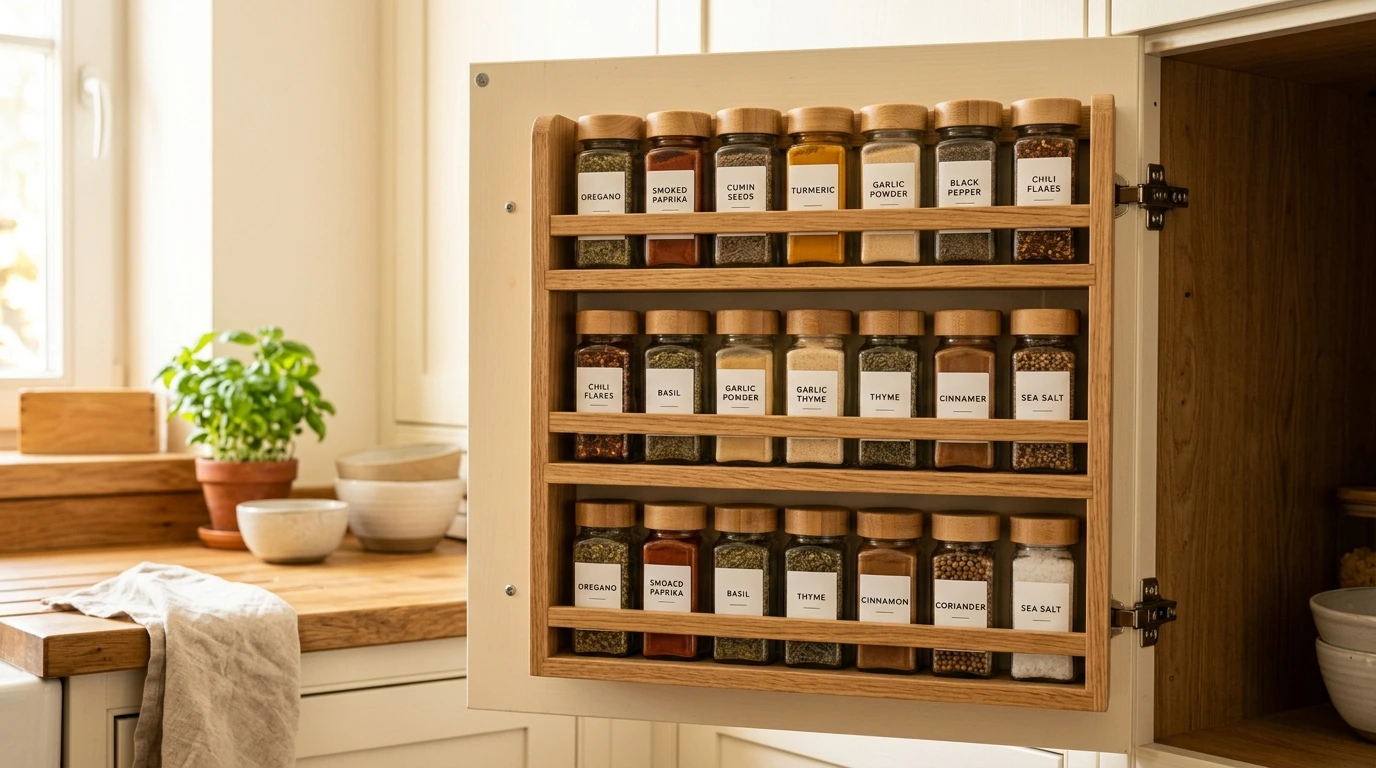
3. A tiered door-mounted rack, attached with adhesive strips for renters, uses space that's otherwise completely wasted inside a cabinet door.
4. A single adhesive hook row can hold a few spice tins with magnetic bottoms directly on the inside of a metal cabinet door, if your cabinets are metal-backed.
We go deeper on this topic in The Best Cabinet Organizers for Small Kitchens (Renter-Friendly).
If you have open wall space near the stove
5. A magnetic strip mounted on the wall (using adhesive mounting) holds spice tins with magnetic bottoms in a thin, flat row, using almost no depth at all.
6. A slim floating shelf, discussed in more depth in our guide to renter-friendly floating shelves, can hold a single row of spice jars within reach of the stove.
7. A wall-mounted tiered rack works well if you want a larger visible collection and have a full section of open wall, not just a narrow strip.
We go deeper on this topic in How to Declutter Your Home Before a Move (Step-by-Step).
If you're short on every kind of space
8. A rotating carousel takes up one small footprint on a shelf or counter but holds a full circle of jars, which is efficient if you can spare a small patch of flat surface.
9. A hanging over-the-door pocket organizer, the kind sold for shoes, can be repurposed for spice packets and small jars on the inside of a pantry or cabinet door.
10. Decanting spices into small, uniform stackable tins lets you use vertical space efficiently even in an odd-shaped leftover cabinet corner, since uniform tins stack more predictably than mismatched original packaging.
A real example: matching the fix to the actual kitchen
In one small kitchen with zero spare drawers and cabinets already at capacity, the instinct was to give up on organized spice storage entirely and keep buying more of whatever was easiest to grab, leading to three separate jars of cinnamon bought within a year because nobody could find the existing ones.
The actual fix didn't require making room anywhere, it used a magnetic strip mounted on the exposed strip of wall beside the stove, paired with small magnetic-bottomed tins for the dozen spices used weekly. The remaining, less-used spices stayed in their original jars in a small bin on a high shelf. Total setup cost was about $22, no drawer or cabinet space was sacrificed, and duplicate spice purchases stopped almost immediately once everything was visible in one place.
The broader takeaway is that spice storage doesn't need to compete with anything else in the kitchen for space, because spices are small enough to fit almost any leftover surface, a strip of wall, the back of a door, the inside of a cabinet panel. The only real planning step is figuring out which spare surface you have before choosing a product shaped for a surface you don't. Once that one decision is made, setting up any of the ten options above typically takes less than half an hour from unboxing to a fully labeled, working system, which makes spice storage one of the fastest wins available in a broader kitchen organizing project, and a good place to start if the rest of the kitchen still feels too overwhelming to tackle all at once.
For more like this, visit our Kitchen Organization guides.
| You have... | Best option | Approx. Cost |
|---|---|---|
| A spare shallow drawer | Stepped drawer insert | $10-$20 |
| Cabinet door space | Tiered door-mounted rack | $10-$25 |
| Wall space near the stove | Magnetic strip + tins | $15-$30 |
| A small counter or shelf footprint | Rotating carousel | $10-$20 |
| Nothing spare at all | Over-the-door pocket organizer | $10-$15 |
Tip
Alphabetizing spices is optional and mostly cosmetic. Grouping by how often you use them, everyday spices in the most reachable spot, occasional ones further back, usually saves more time in real cooking.
Watch Out For
If you decant spices into new containers, always label the new container immediately and note the approximate purchase date, since ground spices lose potency over one to three years and unlabeled jars are impossible to rotate out.
Common Mistakes
- Buying a large tiered rack for a cabinet door that's too shallow to close once it's installed.
- Decanting all spices into matching jars without labeling them first.
- Storing spices directly above the stove, where heat speeds up flavor loss.
- Choosing magnetic tins without checking your cabinets or fridge sides are actually magnetic.
- Buying a large carousel that doesn't fit the shelf or counter footprint you actually have spare.
Quick Recap
- Identify what kind of spare space you actually have: drawer, door, wall, or shelf.
- Match the spice storage type to that space rather than to style alone.
- Group spices by frequency of use, not strictly alphabetically.
- Label any decanted containers immediately, including an approximate date.
- Keep spices away from direct heat sources like the stovetop or oven vent.
Frequently Asked Questions
What's the best spice storage for a tiny kitchen with no cabinets to spare?
A magnetic wall strip or an over-the-door pocket organizer both add spice storage without needing any existing cabinet or drawer space.
Should spices be stored near the stove?
Nearby for convenience is fine, but avoid direct heat exposure, such as a shelf immediately above a burner, since heat accelerates flavor loss.
Is it worth decanting spices into matching jars?
It can improve visibility and stacking efficiency, but only if you label every jar with its contents and an approximate date, since original packaging often has useful expiration information you'd otherwise lose.
How do I organize spices in a drawer instead of a cabinet?
A stepped or tiered drawer insert lets every jar's label stay visible from above, which solves the main problem of flat drawer storage where jars get lost in a single layer.
How often should I replace spices?
Ground spices generally lose potency after one to three years; whole spices last longer. Checking and refreshing your collection once or twice a year keeps the rotation manageable.
Conclusion
There's no single best spice rack, there's only the best option for the specific spare space your kitchen actually has. Take stock of whether you have a shallow drawer, cabinet door, open wall, or just a small shelf footprint, then match the storage type to that space rather than buying based on looks alone. Group by how often you cook with each spice, and your rack will earn its keep every time you're mid-recipe.

Real Home Habits Editorial Team
Real Home Habits Editorial Team writes practical, step-by-step home organization guides for renters, small-space dwellers, and busy families.