Table of Contents
- Priority 1: A stackable shelf riser (~$10)
- Priority 2: Two or three stackable bins (~$15)
- Priority 3: A tension rod (~$8)
- Priority 4: A basic label maker or printed labels (~$12)
- If you have anything left: a magnetic strip or clear containers
- A real example: what $50 actually bought in one small kitchen
- Common Mistakes
- Quick Recap
- Frequently Asked Questions
Quick Summary
With $50, prioritize a shelf riser and a few stackable bins for the pantry, a tension rod for under-sink or lid storage, and a magnetic strip or clear labels rather than a full matching container set. This order targets the areas that cause the most daily friction first, leaving decorative upgrades for later if budget allows.
A full kitchen organization overhaul can easily run into hundreds of dollars once you start adding matching containers, drawer inserts, and wall systems. Most of that isn't necessary to get a genuinely more functional kitchen. This challenge sets a hard $50 limit and prioritizes spending on the changes that solve the most daily friction, in order, so you can stop whenever the budget runs out and still have made real progress.
The plan assumes you've already done the free steps, emptying and sorting, as covered in our guide to organizing a small pantry on a budget, and are ready to spend a modest, fixed amount on the tools that make the system stick.
You might also like The Best Cabinet Organizers for Small Kitchens (Renter-Friendly).
Priority 1: A stackable shelf riser (~$10)
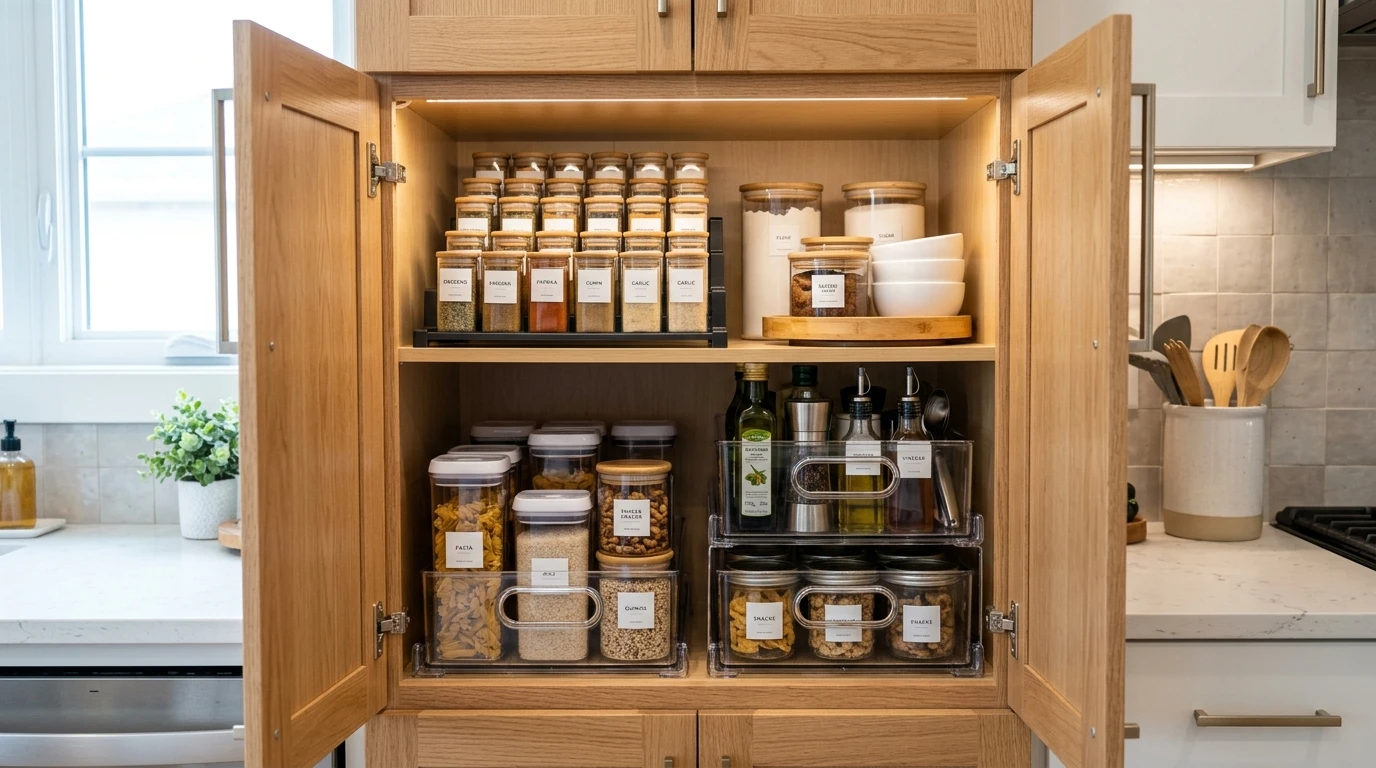
A shelf riser instantly doubles usable space on one pantry or cabinet shelf, which usually has the biggest single impact on visible clutter for the lowest cost of anything on this list.
Priority 2: Two or three stackable bins (~$15)
Targeted at your messiest shelf or drawer, usually snacks, loose packets, or under-sink cleaning supplies, a small set of open-top stackable bins solves the "loose items sliding everywhere" problem more effectively than almost anything else at this price point.
Related reading: Smart Under-Sink Storage Ideas for Apartments.
Priority 3: A tension rod (~$8)
One of the cheapest tools on this list, and one of the most flexible: use it to hang spray bottles under the sink, or mount it inside a cabinet door to organize pot lids upright, whichever solves a bigger problem in your specific kitchen.
Priority 4: A basic label maker or printed labels (~$12)
Labels are what keep an organized kitchen organized past the first week, especially in a shared household. A simple label maker pays for itself the first time it saves you from a bin slowly filling with the wrong items.
If this is useful, you may also want Spring Cleaning Checklist for Small Apartments.
If you have anything left: a magnetic strip or clear containers
With roughly $5 remaining, a small magnetic knife strip or a couple of clear, stackable spice tins are reasonable finishing touches, but they're optional. If the budget is already spent by priority 4, the kitchen will already function meaningfully better than before the challenge.
A real example: what $50 actually bought in one small kitchen
Applying this exact priority order in a one-bedroom apartment kitchen: $9 for a shelf riser in the pantry, $16 for three stackable bins split between the pantry and under-sink cabinet, $8 for a tension rod used for pot lids, and $13 for a basic label maker. Total spend: $46, with $4 left over.
The most noticeable change wasn't any single item, it was that, a month later, the system still looked the way it did on day one. That's the real test of a budget organization project: not how it looks right after you finish, but whether it's still working once daily life pushes back against it. The labels in particular were credited as the reason bins didn't slowly refill with the wrong items over the following weeks.
It's also worth noting what this challenge intentionally skipped: no new dishware, no decorative canisters, no full pantry door makeover. Those are reasonable future upgrades once the budget allows, but none of them were necessary to fix the actual daily friction points. That's the core idea behind a fixed, prioritized budget, it forces a focus on function first, which is usually what a small kitchen needs most, with appearance as a later, optional layer on top. If you finish this challenge and still want to upgrade further, treat it as a second, separate round rather than blending it into the original $50, so you always know exactly what each purchase actually fixed. Looking back, the household also noted that the discipline of sticking to a fixed number, rather than an open-ended budget, made every purchase decision faster, since there was no temptation to keep browsing for something slightly nicer once the $50 was allocated. That constraint, more than the specific dollar figure, is probably the most transferable part of this challenge to any other room in a small home.
See our full Kitchen Organization guides for more related guides.
| Item | Approx. Cost | Solves |
|---|---|---|
| Stackable shelf riser | $10 | Wasted vertical space on one shelf |
| 2-3 stackable open bins | $15 | Loose, sliding items |
| Tension rod | $8 | Lids or under-sink bottles with no home |
| Basic label maker or label sheets | $12 | System breaking down after week one |
| Optional: magnetic strip or small tins | $5 | Counter clutter or spice visibility |
Tip
Do the free, no-cost sorting and zoning steps before you spend anything. Buying organizers first, before you know exactly where the friction points are, is the most common way to overspend on kitchen storage.
Watch Out For
Resist the urge to buy a full matching set "while you're at it." A partial, targeted set that fits your actual shelves works better than a complete set bought without measuring first.
Common Mistakes
- Spending the full budget on one large item instead of spreading it across the priorities that solve the most problems.
- Buying before measuring, then discovering a bin or riser doesn't fit the target shelf.
- Skipping labels to save a few dollars, which is usually the change with the best long-term payoff.
- Treating this as a one-time purchase instead of pairing it with the free sorting and zoning steps.
- Choosing decorative items over functional ones when the budget is tight.
Quick Recap
- Complete the free sorting and zoning steps before spending anything.
- Buy a shelf riser first for the best value per dollar.
- Add 2-3 stackable bins for your messiest current shelf or drawer.
- Get a tension rod for either lids or under-sink bottle storage.
- Finish with labels, even basic ones, to make the system last.
Frequently Asked Questions
Can you really organize a kitchen for $50?
Yes, if you pair the budget with free steps like sorting, decluttering, and zoning first. The $50 goes toward the specific tools that make an already-sorted kitchen stay organized, not toward solving the sorting itself.
What's the single best purchase for kitchen organization on a tight budget?
A stackable shelf riser is usually the highest-value single item, since it adds real usable space to almost any cabinet or pantry shelf for around $10.
Should I buy a matching container set on a budget?
It's usually not worth it early on. A partial set of stackable bins sized to your actual shelves, plus reused containers you already own, solves more problems per dollar than a full matching set.
Is a label maker worth buying for a small kitchen?
For shared households especially, yes, labels are one of the cheapest ways to keep an organized system from sliding back into clutter within a few weeks.
What should I organize first if I only have a little time and money?
Start with whichever shelf or drawer causes the most daily frustration, since that's where a small investment will be felt the most immediately.
Conclusion
You don't need a large budget to notice a real difference in how a small kitchen functions. A shelf riser, a few stackable bins, a tension rod, and a set of labels, in that order, solve the majority of daily friction points for around $50 or less. Do the free sorting work first, spend deliberately in priority order, and stop whenever the budget runs out; even a partial version of this challenge leaves the kitchen more usable than before.

Real Home Habits Editorial Team
Real Home Habits Editorial Team writes practical, step-by-step home organization guides for renters, small-space dwellers, and busy families.